Quick answer
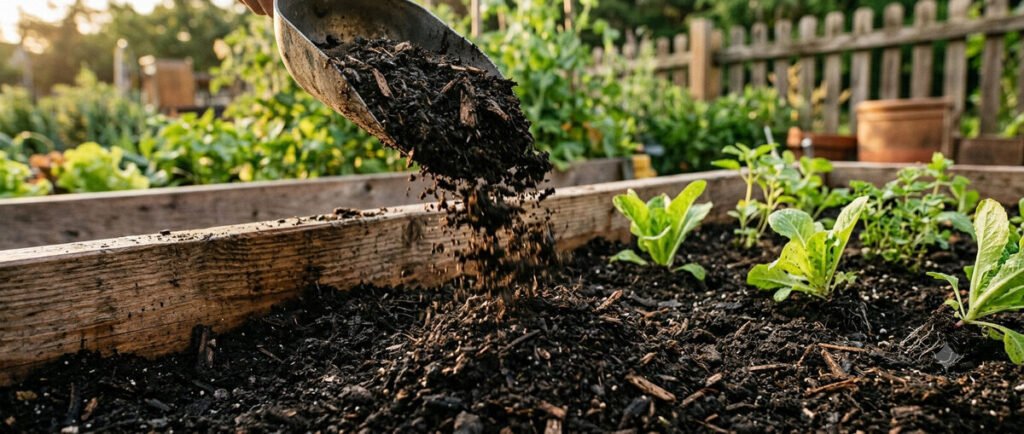
This raised bed soil guide covers what actually works: avoid filling a raised bed entirely with heavy native soil, especially if it’s clay-heavy or poorly drained — it compacts under container-like conditions and brings weed seeds along with it. The gold-standard recipe is Mel’s Mix: equal parts (by volume) blended compost, peat moss or coco coir, and coarse vermiculite. A more budget-friendly alternative is 50% screened topsoil and 50% compost, mixed thoroughly rather than layered. For a standard 4×8-foot bed at 12 inches deep, expect to need roughly 32 cubic feet (about 1.2 cubic yards) of growing mix — and most first-time bed owners underestimate that volume by about a third.
Table of contents
- Why native soil doesn’t work in a raised bed
- Mel’s Mix: the standard recipe
- Budget alternative: topsoil and compost
- How much soil do you actually need
- Filling a deep bed without breaking the bank
- Refreshing soil each season
- Common mistakes
- Frequently asked questions
- How we put this guide together
Why native soil doesn’t work well on its own
The first question in any raised bed soil guide is what not to use. It’s tempting to just dig up soil from elsewhere in the yard and dump it into a new raised bed, but heavy native soil used entirely on its own creates problems once it’s confined to a raised container rather than the open ground — especially clay-heavy soil, common across much of the central and southeastern US.
It can compact. Under the elevated, container-like conditions of a raised bed, clay-heavy native soil is more prone to compacting than it would be in open ground, which restricts root growth and drainage.
It can drain poorly. In open ground, soil stays connected to the water table below and surrounding soil, which helps regulate moisture. Once elevated in a raised bed, that connection is reduced, so poorly-draining native soil can hold water longer than it should.
It arrives with a weed seed bank. Native soil typically carries weed seeds already in it. A raised bed’s warm, well-fed conditions are ideal for germinating those seeds right alongside whatever you actually planted.
This doesn’t mean native soil has no place in a raised bed — a well-drained, loamy native soil blended with compost and aeration amendments can work reasonably well as one component of a mix. The issue is specifically using heavy, poorly-drained native soil as the sole fill, unamended. Purpose-built growing media — or native soil blended thoughtfully with compost and vermiculite or perlite — solves these problems far more reliably, which is why extension services generally recommend against filling raised beds with unamended native topsoil or subsoil.
Mel’s Mix: the standard recipe
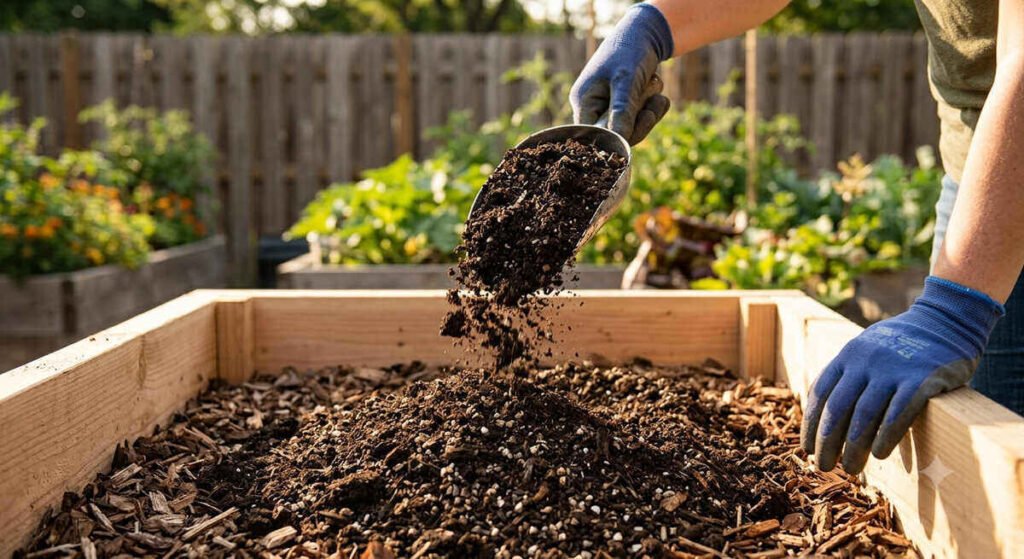
Mel Bartholomew’s Square Foot Gardening mix, introduced in 1981 and still the most widely cited raised bed recipe, is built from three equal parts by volume:
- 1/3 compost — ideally blended from multiple sources (yard waste compost, food-scrap compost, aged manure compost, mushroom compost) rather than a single type, since compost diversity provides a broader, more balanced nutrient profile than any one source alone.
- 1/3 peat moss or coco coir — retains moisture and improves overall soil structure.
- 1/3 coarse vermiculite — holds water while improving aeration, preventing the compaction that ruins native soil in a raised bed.
This mix drains well, holds moisture and nutrients, and resists compacting over time — genuinely closer to a large container growing medium than garden soil, which is really what a raised bed is.
The tradeoff: it’s the most expensive of the common recipes, largely due to the cost of coarse vermiculite and peat moss at volume. For a single small bed this is a manageable one-time cost; for multiple large beds, the budget alternative below is worth considering.

Budget alternative: topsoil and compost
A simpler, less expensive recipe performs nearly as well for most home vegetable gardens: 50% screened topsoil, 50% high-quality compost, mixed together thoroughly rather than layered. Once combined and settled into the bed, this blend generally doesn’t need tilling in future seasons — just top-dressing with fresh compost as it settles.
This isn’t identical to Mel’s Mix — screened topsoil still carries more risk of compaction over time than a vermiculite-based mix — but for gardeners prioritizing cost over the absolute best possible drainage and aeration, it’s a well-established, reasonable alternative rather than a corner-cutting compromise.
How much soil do you actually need
Underestimating volume is the single most common budgeting mistake first-time raised bed owners make — most people underestimate by roughly a third, then either run a bed under-filled or make an unplanned second trip.
The formula: length × width × depth (all in feet) = cubic feet. Divide by 27 to convert to cubic yards if you’re buying soil in bulk rather than bagged.
| Bed size | Depth | Volume needed |
|---|---|---|
| 4×4 ft | 12″ | 16 cubic feet |
| 4×8 ft | 12″ | 32 cubic feet |
| 4×8 ft | 18″ | 48 cubic feet |
| 3×6 ft | 12″ | 18 cubic feet |
Bulk soil (delivered by the cubic yard) is almost always cheaper per cubic foot than bagged soil once you’re filling anything larger than a small starter bed — worth checking a local landscape supplier’s bulk pricing before defaulting to bags from a garden center.
Raised bed soil calculator
Total volume
32.0 ft³
Cubic yards (bulk)
1.19 yd³
Mel’s mix
| Compost | 10.7 ft³ |
| Peat moss / coir | 10.7 ft³ |
| Vermiculite | 10.7 ft³ |
Budget mix
| Topsoil | 16.0 ft³ |
| Compost | 16.0 ft³ |
Formula: length × width × depth ÷ 27 = cubic yards. Estimate only — actual bags/bulk needed may vary slightly by supplier measurement.
Filling a deep bed without breaking the bank
For beds deeper than about 12 inches, filling the entire depth with a premium mix like Mel’s Mix gets expensive fast, and premium mix isn’t necessarily needed for the full depth of every deep bed — most root activity for common vegetables concentrates in the top 10-12 inches.
One option some gardeners use in certain situations, sometimes called hugelkultur-style layering: fill the bottom several inches with coarser, cheaper organic material — wood chips, small branches, or partially composted yard waste — and reserve full soil mix for the top layer. Proponents note that buried woody material breaks down slowly over years, adding organic matter as it decomposes. This isn’t a universal recommendation for every deep bed, though — it works best for beds 18+ inches deep growing shallower-rooted crops, and it changes the bed’s drainage and settling behavior in ways worth researching further (via your local extension service) before committing a new bed to it.
If you do use this approach, one caution: leave at least 12-18 inches of true soil mix above any bulk filler for deep-rooted crops like carrots or parsnips specifically, since their roots will grow directly into whatever’s beneath the topsoil layer. For beds growing primarily deep-rooted vegetables, filling the full depth with soil mix remains the more predictable, lower-risk choice.
Refreshing soil each season
Raised bed soil isn’t a one-time fill-and-forget purchase. Compost breaks down and settles over a season, meaning bed volume drops and nutrients deplete even in a well-built mix.
Plan to add roughly 2-3 inches of fresh compost per season to maintain fertility and top off settled volume, rather than assuming the original fill will last indefinitely. This is far cheaper than a full refill and is standard maintenance for any actively used raised bed, regardless of which original recipe you used.
Common mistakes
Using heavy native soil unamended. Covered above — clay-heavy native soil used entirely on its own can compact, drain poorly, and import weed seeds.
Underestimating volume. Measure length × width × depth before ordering, and round up rather than down.
Using a single compost source. A mix of composts (yard waste, food scraps, manure, mushroom) provides a more balanced nutrient profile than relying on one bagged type alone.
Skipping the settling allowance. Soil settles noticeably in the first few weeks after filling — leave the bed slightly overfilled initially rather than filling exactly to the rim.
Never refreshing. Treating the initial fill as permanent leads to depleted, compacted soil by year two or three. Annual compost top-dressing is standard maintenance, not optional.
Frequently asked questions
Can I use bagged garden soil instead of mixing my own? Some bagged “raised bed soil” or “garden soil” blends are formulated appropriately for raised beds, but read the label carefully — many bagged products labeled simply “garden soil” or “topsoil” are intended for in-ground use and will compact the same way native soil does. Look specifically for blends marketed for raised beds or containers.
Do I need to replace all the soil every year? No — a well-built raised bed mix lasts for years with proper seasonal maintenance (adding 2-3 inches of fresh compost annually). Full replacement is rarely necessary unless the bed has a specific problem like persistent disease or severe compaction.
Is vermiculite necessary, or can I skip it? Vermiculite specifically improves aeration and water retention simultaneously, which is difficult to replicate with topsoil and compost alone. It’s not strictly required — the budget topsoil-and-compost mix works reasonably well without it — but it’s a meaningful quality difference, not just a Mel’s Mix brand detail.
What pH should raised bed soil be? Most vegetables do well in a slightly acidic to neutral range, roughly pH 6.0-7.0. A soil test from your local cooperative extension service is the most reliable way to check, since compost source and local water can shift pH meaningfully from recipe to recipe.
Can I mix my own compost into a raised bed instead of buying it? Yes, and it’s a good way to reduce cost over time — homemade compost from yard waste and food scraps works well as part of a blended compost source, ideally combined with at least one or two other compost types for nutrient diversity rather than relying on homemade compost alone.
How we put this guide together
This guide is built from published horticultural extension guidance, established gardening references (including Mel Bartholomew’s Square Foot Gardening), and aggregated grower experience — not from in-house soil testing at this time. Where a specific recipe or ratio comes from a named source, we’ve attributed it as such. As we complete our own soil testing across raised bed setups, we’ll update this guide with first-hand results.
Further reading
- University of Maryland Extension: Raised Bed Gardening — depth and soil-mix guidance from a land-grant extension program.
- Our Raised Bed vs Container Gardening guide, if you haven’t yet decided between the two approaches.
- Our Best Raised Garden Beds comparison, for choosing the bed itself before filling it.
Next in this series: Best Self-Watering Planters for Patios & Balconies.
The GoEfte editorial team researches and compares yard, garden, and water products, drawing on manufacturer specs, horticultural extension guidance, and verified owner reviews to help homeowners choose the right gear for their space and budget.