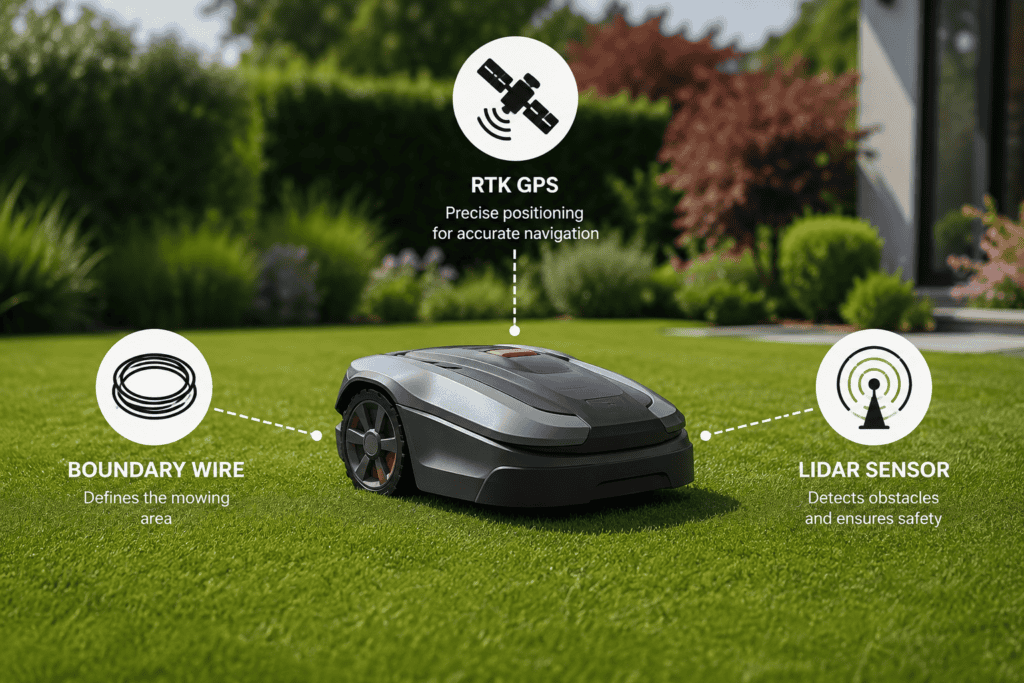
If you’ve started shopping for a robotic mower, you’ve probably run into three unfamiliar terms in the first five minutes: RTK, LiDAR, and boundary wire. Every mower on the market uses one of these (or a combination), and which one your mower uses affects setup time, cost, reliability under trees, and how the mower behaves near your flower beds and fence lines.
This isn’t a buying guide with product picks — it’s the explainer that makes the rest of your research make sense. Once you understand how these three systems work, every spec sheet you look at afterward will actually mean something.
The three approaches, in plain English
1. Buried boundary wire
This is the original robotic mower technology, and it’s still in wide use. A thin wire is buried (or pinned to the ground) around the perimeter of your lawn and around anything you want the mower to avoid — flower beds, ponds, trees. A low-voltage signal runs through the wire, and the mower’s onboard sensor detects that signal to know where the “wall” is.
How it works day to day: the mower drives in a semi-random pattern within the wired boundary, turning and changing direction whenever it detects the wire signal, until the lawn is covered.
Strengths: it’s the most bulletproof option available. Signal doesn’t degrade under tree cover, doesn’t get confused by satellite interference, and doesn’t require line-of-sight to anything. For genuinely tricky properties — heavy canopy, oddly shaped beds, lots of no-go zones — this remains the most dependable choice.
Trade-offs: installation is physical labor. Burying or pinning wire around your whole property takes real time, and every layout change (a new garden bed, an extended patio) means digging up and moving wire. It’s also the least “smart” of the three — the mower doesn’t build a map, it just reacts to the wire in real time.
2. RTK GPS (Real-Time Kinematic GPS)
RTK is what most people mean when they say “wire-free” mower. Regular phone GPS is accurate to a few meters — nowhere near precise enough to keep a mower off your driveway. RTK fixes that by pairing satellite positioning with a fixed reference point on your property (usually a small base station), which corrects the satellite signal down to centimeter-level accuracy.
How it works day to day: during setup, you walk the mower around your property’s perimeter and any no-go zones using a phone app, and it builds a virtual boundary map from GPS coordinates instead of a physical wire. From then on, it navigates by checking its position against that saved map.
Strengths: no digging, no wire, and boundaries are easy to edit — resize a zone in the app instead of moving physical hardware. Setup for a straightforward lawn can often be done in under an hour.
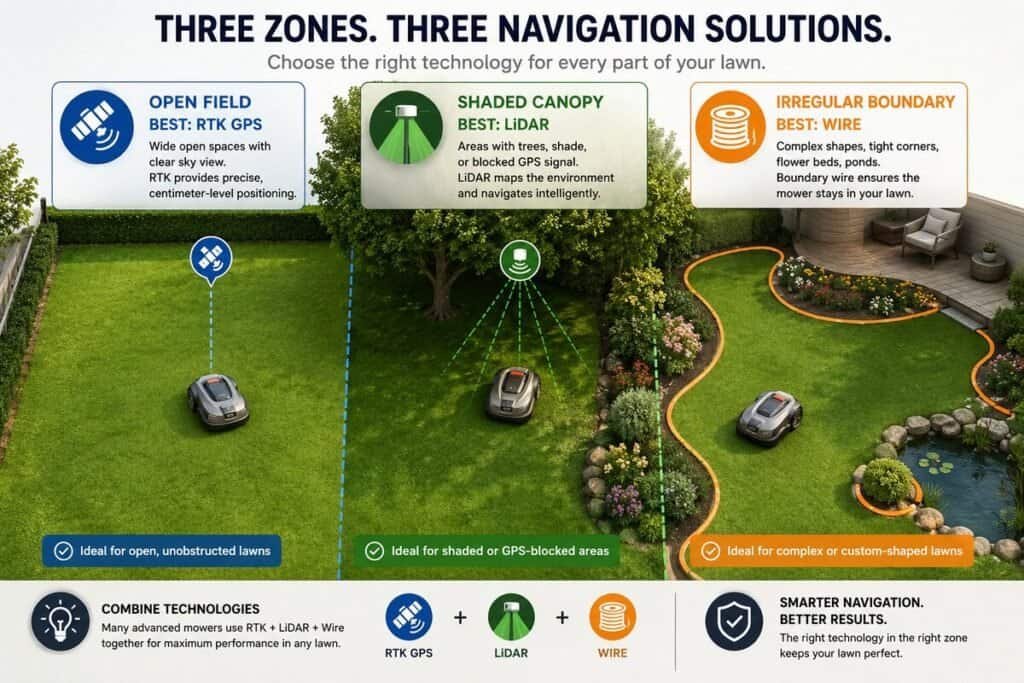
Trade-offs: RTK depends on a clear view of the sky. Dense, continuous tree canopy can block or degrade the satellite signal, causing the mower to lose precision or stop. This is why most current RTK mowers pair GPS with a secondary camera-based vision system as a fallback — when satellite signal drops, the mower switches to visually tracking its surroundings until it reacquires signal. Even with that backup, heavily shaded yards remain the toughest scenario for any GPS-based system.
3. LiDAR (Light Detection and Ranging)
LiDAR takes a completely different approach: instead of relying on satellites at all, the mower uses a spinning laser sensor (often mounted on top, giving it a 360° view) to build a real-time map of the physical objects around it — fences, trees, structures, garden beds — the same core technology used in some robot vacuums and self-driving cars.
How it works day to day: the mower maps your yard by physically scanning its surroundings as it moves, then uses that map to navigate and recognize the boundary without ever checking a satellite signal.
Strengths: because it doesn’t depend on GPS at all, LiDAR sidesteps the tree-cover problem entirely. It’s the strongest option specifically for yards with heavy, continuous canopy where RTK systems struggle most.
Trade-offs: LiDAR mowers are newer to this category than RTK or wired systems, and pure line-of-sight scanning can be affected by very tall grass or dense obstacles blocking the sensor’s view at ground level. They also tend to sit at a higher price point than comparable RTK models.
Quick comparison
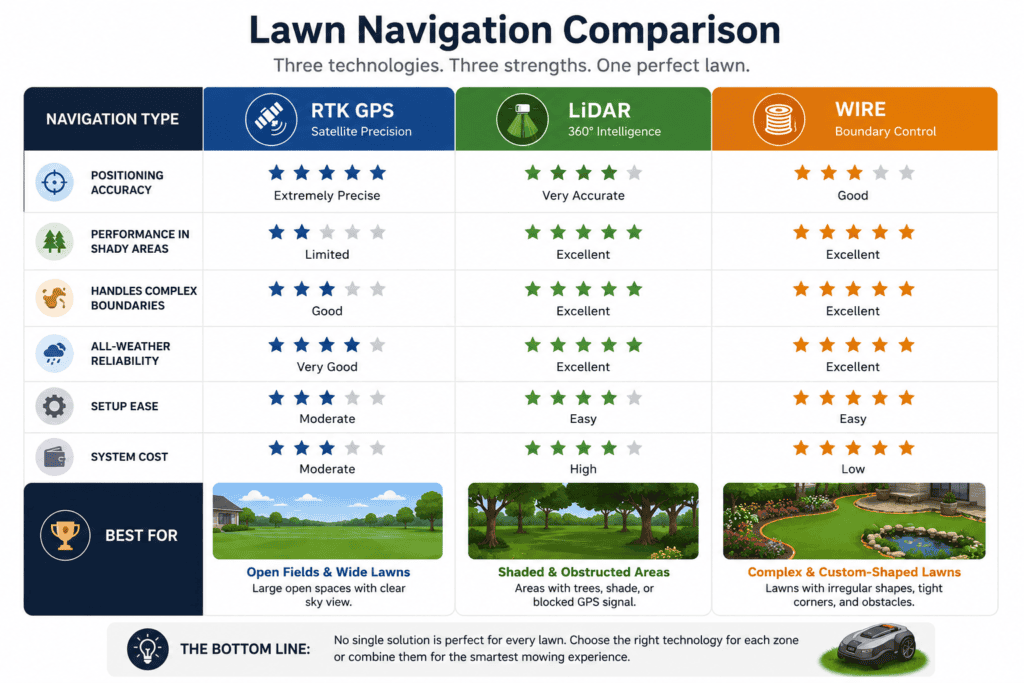
| Boundary Wire | RTK GPS | LiDAR | |
|---|---|---|---|
| Setup effort | High (physical install) | Low–moderate (app-based mapping) | Low–moderate (app-based mapping) |
| Works under heavy tree cover | Yes | Weaker — needs vision backup | Yes |
| Boundary changes later | Requires re-digging wire | Edit in-app | Edit in-app |
| Typical cost | Lower hardware cost, but install labor | Mid to premium | Mid to premium |
| Best suited for | Complex, obstacle-heavy yards | Open-to-moderately shaded yards | Heavily shaded yards |
Does the navigation type affect slope handling?
Not directly — slope-climbing ability comes down to the mower’s wheels, motors, and traction system (standard drive vs. all-wheel-drive), not its navigation method. You can have an RTK mower with poor slope performance and a wire-guided mower with excellent slope performance, and vice versa. Don’t assume navigation tech tells you anything about hill capability — check the slope rating separately.
One spec worth understanding either way: main-lawn vs. edge-cutting rating
Regardless of which navigation type a mower uses, manufacturers typically publish two different slope numbers: a main-lawn rating and a (usually lower) edge-cutting rating. The main-lawn number reflects the mower crossing open, uninterrupted grass. The edge rating — the one that matters if your slope runs right up to a fence line or flower bed — is usually several degrees lower, because wheel traction drops right at a boundary. It’s a detail that applies across all three navigation types, and it’s easy to miss if you only look at the headline slope percentage.
So which one is right for you?
That depends entirely on your specific yard, which is exactly why this isn’t a buying guide — the right answer for a flat quarter-acre lot with no trees looks completely different from the right answer for a half-acre property with mature oak trees and a steep back slope. We break that down, model by model, in our full buying guide by lawn size, slope, and tree cover.
Frequently asked questions
Can a robotic mower use more than one navigation type at once? Yes — this is increasingly common. Many current RTK mowers pair satellite positioning with a camera-based vision system specifically to handle the moments when GPS signal drops under trees, giving you most of RTK’s convenience with a partial safety net for shaded areas.
Is boundary wire outdated? Not exactly — it’s older technology, but it’s still the most reliable option for certain properties, particularly ones with dense tree cover, unusual layouts, or a lot of no-go zones. “Older” and “worse” aren’t the same thing here; it’s a genuine trade-off between install effort and reliability.
Do I need a base station for RTK mowers? Most RTK systems require a small reference station mounted somewhere on your property with a clear view of the sky. Some newer models use “NetRTK,” which pulls correction data over Wi-Fi or cellular instead of a physical base station — worth checking for on the spec sheet if you want to avoid installing hardware.
Will LiDAR mowers become the standard eventually? It’s too early to say. Each approach has genuine strengths for different yard types, and manufacturers are increasingly combining technologies (RTK + vision, LiDAR + RTK) rather than any single approach fully replacing the others.
The GoEfte editorial team researches and compares yard, garden, and water products, drawing on manufacturer specs, horticultural extension guidance, and verified owner reviews to help homeowners choose the right gear for their space and budget.


