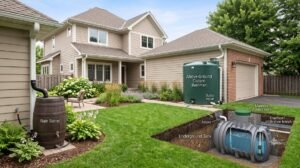
Finding the best rain barrels for your yard starts with a simple bit of math: a single inch of rain falling on a 1,000-square-foot roof generates roughly 600 gallons of runoff — most of which currently disappears down a downspout and off your property. A rain barrel captures a meaningful slice of that for free, but the category now spans everything from a $30 DIY diverter kit paired with a scavenged drum to a $185 decorative barrel that reads as a garden urn. The right pick depends on how much water you actually want to store, whether looks matter for where it’ll sit, and whether you want gravity-fed flow or enough pressure to actually run a hose.
Updated: July 2026. Pricing reflects current published retailer data — always confirm against the live listing before buying, since promotions shift often. Before installing, confirm rainwater harvesting is unrestricted in your state — see our state-by-state legality guide.
We compared current leading models from FCMP Outdoor, RTS Home Accents, Algreen, Good Ideas, and EarthMinded against the criteria that matter most for homeowners: capacity, material durability, decorative options, diverter/overflow design, and whether a pump is included for pressurized output.
Quick answer: for most homeowners, the FCMP Outdoor Raincatcher 4000 is the safest all-around 50-gallon pick. If looks matter for a front-yard spot, go Algreen Castilla or Good Ideas. If you need pressurized flow for a hose or soaker line, go with an Algreen pump-kit system. If budget is the only priority, a DIY diverter kit paired with your own food-grade drum beats every retail-ready barrel on price.
Top picks at a glance
| Category | Model | Best for |
|---|---|---|
| Best overall | FCMP Outdoor Raincatcher 4000 (50 gal) | Clean design, easy downspout fit, linkable |
| Best decorative / front-yard | Algreen Castilla (50 gal) | Pottery-look finish for HOA-visible placement |
| Best with built-in diverter | EarthMinded Aquabarrel FlexiFit kit | Add-your-own-barrel flexibility, no cutting downspout |
| Best for pressurized watering | Algreen 80-Gallon with 500 GPH Pump | Runs soaker hoses and light spray without a separate pump |
| Best mini / small-space | RTS Home Accents 35-Gallon with Planter | Small yards, tight side-yard placement |
| Best budget DIY | EarthMinded FlexiFit diverter + your own 55-gal drum | Lowest true cost per gallon of storage |
Image
The picks, one by one
Best overall: FCMP Outdoor Raincatcher 4000 (50 gallon)
The Raincatcher 4000 is a 50-gallon water storage barrel made from recycled, UV-inhibited, BPA-free polyethylene, built for homeowners who want a clean, modern look paired with practical functionality. A large intake opening makes it forgiving if your downspout isn’t perfectly centered, and the wide mesh screen keeps out leaves and debris while still allowing strong flow during heavy storms. Rigid polyethylene barrels from FCMP, RTS, and Algreen offer the best long-term durability, resisting UV fading and holding their shape for years of weather exposure. Current retail pricing runs around $130, which puts it near the entry point for a full-featured, ready-to-install barrel rather than a bare-bones option.
Good for: most homeowners who want a no-drama barrel that installs in an afternoon and can link to a second unit later. Skip if: you want a decorative finish for a highly visible front-yard spot — step up to Algreen or Good Ideas for that.

Best decorative pick: Algreen Castilla (50 gallon)
The Algreen Castilla, priced around $185, is the top choice for front-yard or HOA-visible placement thanks to an authentic pottery-like texture that’s indistinguishable from a decorative garden urn at normal viewing distance, built with roto-molded construction. Algreen’s UV-stabilized resin formulation is built to extend service life well beyond budget barrels using thinner, non-UV-stabilized plastic, which can begin cracking within 3–5 years in high-UV climates like the Southwest or Florida.
Good for: anyone whose barrel will sit somewhere visible — front yards, near a porch, or in an HOA community with aesthetic rules. Skip if: the barrel will live behind a fence or shed where nobody sees it — you’re paying a real premium for looks you won’t show off.

Best with a built-in diverter system: EarthMinded Aquabarrel FlexiFit
Rather than selling a fixed barrel, EarthMinded’s FlexiFit diverter kit lets you convert almost any watertight container into a working rain barrel. The FlexiFit diverter is specifically designed to help prevent overflow and flooding compared to standard top-fill rain barrel designs. Installation requires no cutting off of the downspout — you drill a hole, insert the diverter, and connect a hose to the hose seal. Retail pricing for the diverter kit itself runs around $30, making it the cheapest way into the category if you already have, or can source, a suitable barrel.
Good for: anyone repurposing a food-grade drum or an existing container instead of buying a purpose-built barrel, and anyone who wants overflow protection without a full barrel redesign. Skip if: you want a single ready-to-use product out of the box — this is a component, not a complete barrel.

Best for pressurized watering: Algreen 80-Gallon Rain Barrel with 500 GPH Pump
Plain rain barrels rely on gravity, which is fine for filling a watering can but not for running a hose or sprinkler. The Algreen system pairs an 80-gallon barrel with a 500 GPH submersible pump designed specifically for the application, arriving as a matched, ready-to-connect set. That 500 GPH pump translates to roughly 8.3 gallons per minute — adequate for soaker hoses and moderate spray applications on gardens up to about 500 square feet, though it won’t power a full sprinkler system. Gravity-fed flow alone from a barrel this size runs about 0.75 to 2 gallons per minute, which is why the matched pump is the actual upgrade here, not just the larger tank.
Good for: anyone who wants to water garden beds with an actual hose rather than hauling watering cans, without sourcing and sizing a separate pump. Skip if: you need to run a full irrigation zone or multiple sprinkler heads — step up to a larger cistern with a higher-flow pump for that.

Best mini / small-space pick: RTS Home Accents 35-Gallon with Planter
For a small yard or a tight side-yard spot where a full 50-gallon barrel won’t fit, a 35-gallon unit with a built-in planter top adds usable space back rather than just taking up a footprint. It follows the same flat-back, downspout-adjacent design as RTS’s larger 50-gallon model, just sized down.
Good for: small lots, townhomes, or anywhere a full-size barrel would dominate the space it sits in. Skip if: you’re watering more than a small container garden — 35 gallons empties fast during an active growing season.

Best budget approach: DIY diverter + your own drum
Pairing the EarthMinded FlexiFit diverter with a locally sourced food-grade 55-gallon drum, typically $20 to $50 from a beverage distributor or restaurant supplier, delivers a complete system for under $80 — genuinely cheaper than any retail-ready barrel, though it requires adding the spigot, screen, and overflow port yourself.
Good for: budget-conscious buyers comfortable with a short DIY assembly step. Skip if: you want a finished, matched-look product with zero assembly.
How to actually choose: match the barrel to your yard and your goal
Capacity vs. roof size. Rain barrels are inherently limited compared to cisterns, typically holding 50 to 80 gallons per barrel, which fills fast during a real storm — link multiple barrels via side ports on models like the FCMP Raincatcher if you want more total capacity without a single oversized tank.
Material and climate. Roto-molded, UV-stabilized polyethylene from FCMP, RTS, and Algreen holds up for years in full sun; thinner budget plastics can crack within a few seasons in high-UV climates.
Gravity flow vs. pump. A standard barrel gives you enough pressure for a watering can, not a hose or sprinkler. If you want to actually run a hose, budget for a matched pump kit (like the Algreen 500 GPH system) rather than assuming any barrel can pressurize a hose on its own.
Overflow and diverter design. Look for a barrel with a built-in overflow system that diverts excess water away from the house, plus an anti-debris and bug screen at the intake — both prevent the two most common rain barrel headaches: foundation water damage and mosquito breeding.
Winterization. Barrels can freeze and crack in cold climates without proper winterization — drain and disconnect before the first hard freeze in any climate that sees sustained sub-freezing temperatures.
Check legality before buying. As of 2026, several U.S. states restrict or cap residential rainwater collection by volume, and some require permits above a certain gallon threshold — see our full state-by-state legality guide before installing anything.

Frequently asked questions
How much water can I actually collect from a rain barrel? A 1-inch rainfall on a 1,000-square-foot roof section generates roughly 600 gallons of runoff, far more than a single 50-to-80-gallon barrel can hold. In practice, a barrel fills quickly during any real storm and is best thought of as capturing the first portion of runoff for reuse, not storing an entire storm’s worth of water.
Can a rain barrel run my sprinkler system? No, not on gravity alone. Standard rain barrels produce well under 2 gallons per minute of gravity-fed pressure, enough for filling a watering can but not for sprinklers or long hose runs. A matched submersible pump kit (500 GPH or higher) can support soaker hoses and light spray watering, but not a full irrigation zone.
Do I need to winterize a rain barrel? Yes, in any climate with sustained freezing temperatures. Drain the barrel and disconnect it from the downspout before the first hard freeze — water left inside can freeze, expand, and crack the barrel, which is one of the two main failure modes alongside UV degradation.
Is rainwater from a barrel safe to drink? No. Collected rainwater from a standard barrel isn’t suitable for drinking without proper filtration and treatment. It’s intended for garden and lawn irrigation, not potable use.
Is a DIY diverter kit actually cheaper than buying a barrel? Yes, if you already have or can source a suitable food-grade drum. A diverter kit alone runs around $30, and a food-grade 55-gallon drum from a local distributor typically costs $20–$50 — a complete system under $80, versus $130+ for most ready-made barrels. The trade-off is assembling the spigot, screen, and overflow port yourself.
How we put this comparison together
This roundup is built from published manufacturer specifications, verified retailer listings, and aggregated third-party test data and owner feedback for each model — not from in-house hands-on testing at this time. Where a claim comes from a manufacturer spec sheet or a single review source rather than something we’ve independently verified, we’ve tried to frame it that way. As we complete hands-on testing on individual barrels, we’ll update this post and link out to full individual reviews with our own first-hand notes.
Next in this series: Best Underground Water Tanks, and First Flush Diverters Explained.
Sources referenced
- https://www.bobvila.com/reviews/best-rain-barrel-options/
- https://findingdulcinea.com/best-rain-barrels
- https://www.theconsumers.guide/reviews/best-rain-barrels-water-collection-2026
- https://www.homedepot.com/p/EarthMinded-DIY-Rain-Barrel-Diverter-and-Parts-Kit-RBK-0001/203256576
- https://www.amazon.com/EarthMinded-Barrel-Diverter-Downspouts-Downpipe/dp/B076BC2MV9
- https://www.ebay.com/p/1928291572
- https://www.ofzenandcomputing.com/best-rainwater-harvesting-barrel-systems-with-pumps/
- https://www.rosenberryrooms.com/best-rainwater-harvesting-barrel-systems-with-pumps/
- https://www.trees.com/gardening-and-landscaping/best-rain-barrels
The GoEfte editorial team researches and compares yard, garden, and water products, drawing on manufacturer specs, horticultural extension guidance, and verified owner reviews to help homeowners choose the right gear for their space and budget.