If you’ve ever wondered how a smart irrigation controller knows when to water — even before your lawn starts looking dry — the answer lies in weather data and evapotranspiration (ET). Unlike traditional sprinkler timers that follow a fixed schedule, smart controllers continuously adjust watering based on local conditions, helping homeowners save water while keeping landscapes healthy.A traditional sprinkler timer doesn’t know it’s raining. It runs on a fixed schedule — every Tuesday and Friday at 6 a.m., rain or shine — because that’s all a clock timer was ever designed to do. Understanding how a smart controller actually makes its watering decisions is the difference between buying the right controller and buying a glorified timer with an app attached.
Key takeaways
- Smart controllers water based on plant water loss (evapotranspiration), not a fixed calendar. Weather data and ET calculations reduce unnecessary watering automatically.
- Proper zone setup — soil type, sun exposure, sprinkler type — is essential for accurate scheduling.
- WaterSense-certified models may qualify for local utility rebates.
- Most homeowners can reduce outdoor water use by roughly 30–50% with weather-based scheduling.
Traditional timer vs. smart controller
| Traditional Timer | Smart Irrigation Controller | |
|---|---|---|
| Schedule | Fixed | Adjusts daily |
| Weather awareness | Ignores forecasts | Uses weather forecasts and ET data |
| Seasonal changes | Manual reprogramming | Automatic adjustment |
| Watering during rain | Can still run | Skips or reduces automatically |
| Typical water use | Higher | ~30–50% lower |
How smart irrigation controllers work, in 5 steps
- Collect local weather data from the nearest station or a network of hyperlocal sources.
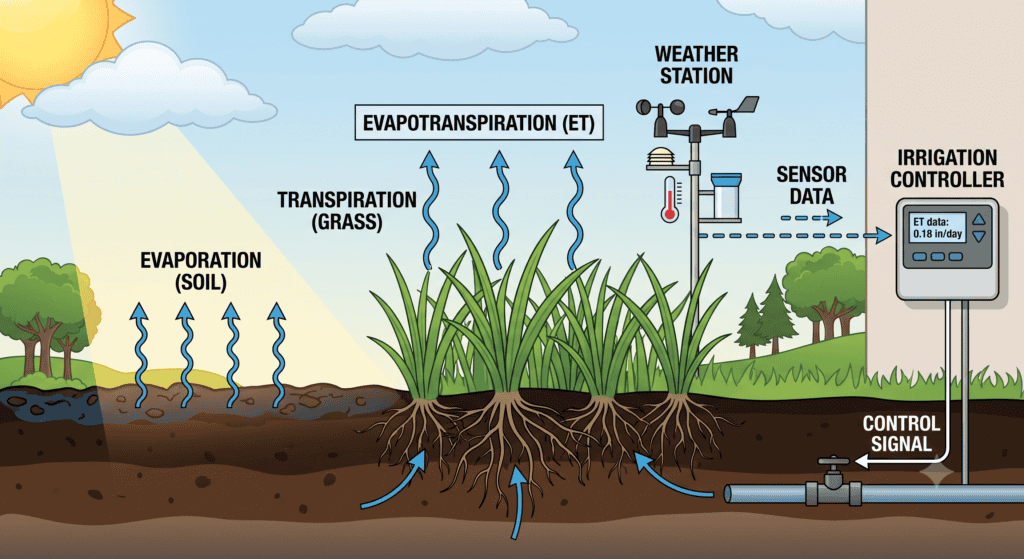
- Calculate evapotranspiration (ET) — how much water the soil and plants lost that day.
- Compare ET against your zone’s setup — soil type, sprinkler type, sun exposure, and plant needs.
- Adjust watering duration up or down as a “water budget” percentage of the baseline schedule.
- Skip watering entirely when recent rainfall already covered the calculated water loss.
The core idea: watering based on water loss, not a calendar
Smart controllers don’t just check “is it raining today.” The good ones calculate evapotranspiration, or ET — a measurement of how much water a given patch of land is losing to evaporation from the soil and transpiration through plant leaves, based on temperature, humidity, wind, and sunlight. Instead of watering on a fixed schedule, the controller tries to replace roughly the amount of water your lawn actually lost that day.
This matters because a fixed schedule tends to badly overwater in cool, humid weather and badly underwater during a hot, dry stretch — exactly backwards from what your lawn needs.
Where the weather data actually comes from
Most smart controllers pull data from the nearest weather station (or a network of hyperlocal stations) via Wi-Fi, factoring in real-time conditions like precipitation, wind speed, humidity, and freezing temperatures. Some premium controllers use a weighted composite of multiple nearby stations specifically so a storm that misses your exact zip code but hits the region can still be factored in reasonably.
This is also why a controller’s watering decisions can occasionally look “wrong” from your window — it’s not reacting to what’s happening in your yard right this second, it’s reacting to a forecast and recent conditions across a wider area. Rain sensors (a small physical add-on some systems support) can supplement this with direct, on-site measurement for zones where hyperlocal accuracy matters more.
What a “water budget” actually means
Rather than a single on/off decision, most smart controllers calculate a water budget — a percentage adjustment applied to your baseline schedule. If ET data suggests your lawn lost less water than usual this week (cooler, cloudier), the controller might run at 70% of a normal cycle. During a hot, dry stretch, it might run at 130%. This is also how these systems automatically transition your lawn’s watering needs from spring to summer to fall without you manually adjusting anything — the water budget shifts gradually as conditions change, rather than needing you to reprogram the schedule each season.
Why the same brand of controller can behave differently on two properties
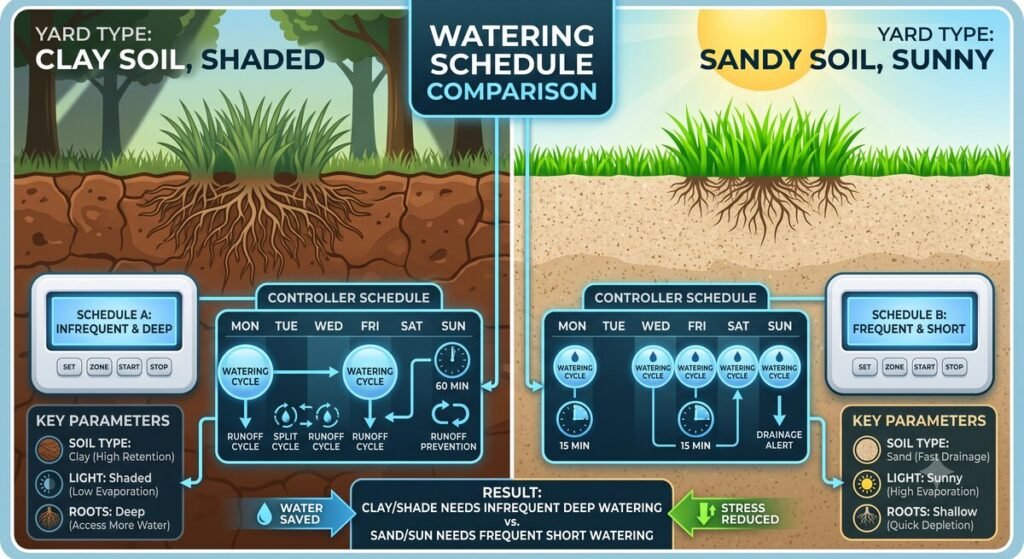
Water budgets aren’t just about weather — they’re also about your specific setup. A well-configured system accounts for your soil type (clay retains water differently than sandy soil), your sprinkler head type (spray heads apply water faster than drip lines), sun exposure per zone, and slope (water runs off a slope faster than it can absorb). This is why the initial setup process — where you tell the app what’s actually planted in each zone and what kind of soil and sun exposure it gets — matters more than people expect. A smart controller with lazy default settings performs barely better than a dumb timer; the intelligence comes from combining good weather data with an accurately configured system.
Expert tip: Spend a few extra minutes entering accurate soil type, sprinkler head type, and sun exposure during setup. These settings often have a bigger impact on watering accuracy than choosing a more expensive controller.
What “WaterSense certified” actually verifies
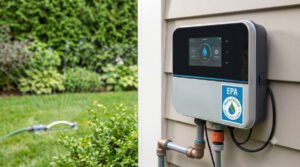
According to the U.S. Environmental Protection Agency (EPA), WaterSense-labeled irrigation controllers use local weather conditions or on-site measurements to help reduce unnecessary outdoor water use — it’s a performance certification, not just a marketing badge. It’s also the detail to look for if you want to qualify for a local utility rebate, since many rebate programs specifically require WaterSense certification as a condition of the rebate, rather than just “any smart controller.”
Further reading from trusted sources
- EPA WaterSense program — official certification criteria and rebate-eligible product search
- Irrigation Association — industry standards and professional certification body for irrigation
- NOAA weather resources — the underlying weather data source many controllers draw from
Frequently asked questions
Do I need a separate rain sensor if my controller already uses weather data? Not necessarily, but it can improve accuracy in specific situations — hyperlocal microclimates, or properties where regional weather data doesn’t reflect what’s actually happening on-site (heavy tree cover creating shade patterns, for example). Most homeowners get solid results from weather-data-only scheduling, and add a physical rain sensor later only if they notice consistent mismatches.
Will a smart controller work correctly right out of the box, or does it need setup? It needs setup to perform well. The weather-based intelligence is only as good as the information you give it about each zone — soil type, sun exposure, plant type, and sprinkler head type all affect the calculation. Skipping this step and leaving default settings is the most common reason people feel underwhelmed by a smart controller’s results.
Does a smart controller still work if my Wi-Fi goes down? This varies by model. Some controllers fall back to a locally cached schedule and continue operating using the last known water budget until connectivity returns; others may pause smart adjustments until they reconnect. If offline reliability matters to you specifically, it’s worth checking a model’s specs for on-site fallback behavior before buying.
How much water does this actually save compared to a normal timer? Weather-based scheduling that skips or adjusts watering based on real conditions typically reduces water waste by roughly 30–50% compared to a fixed timer, according to industry comparisons — though the exact number depends heavily on your climate and how well the system is configured.
Conclusion
Smart irrigation controllers are designed to replace guesswork with data-driven watering. By combining local weather information, evapotranspiration calculations, and details about your landscape, they deliver water only when plants actually need it. The result is healthier lawns, lower water bills, and less wasted water — especially when the controller is configured correctly and paired with efficient irrigation hardware.
The GoEfte editorial team researches and compares yard, garden, and water products, drawing on manufacturer specs, horticultural extension guidance, and verified owner reviews to help homeowners choose the right gear for their space and budget.