Quick answer
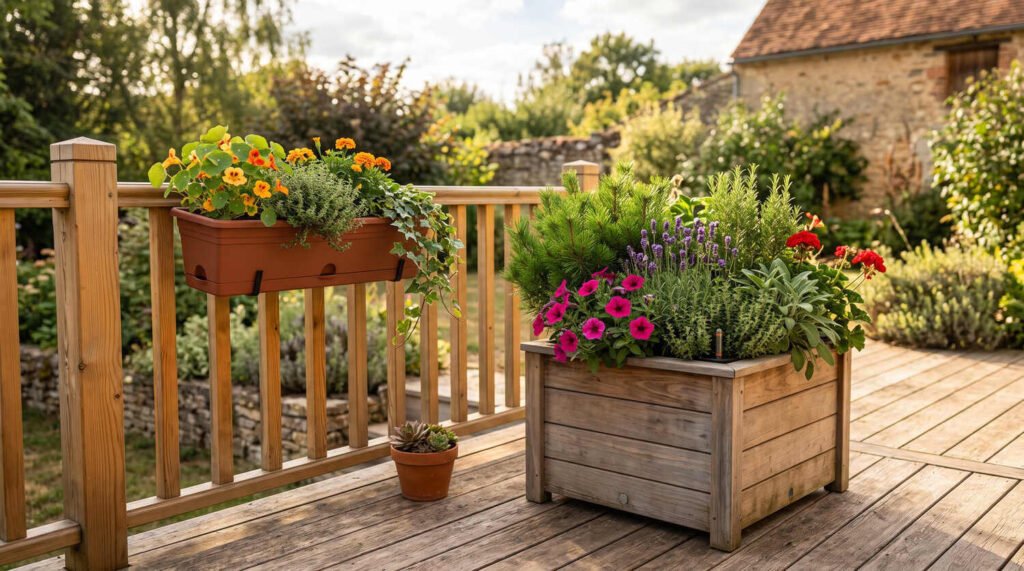
For best self-watering planters for patios and balconies, the right pick depends more on your space and plant type than on brand. For a general-purpose patio planter with real longevity, the Mayne Fairfield — double-wall polyethylene construction and a 15-year residential warranty — is the safest all-around choice. If you’re specifically growing tomatoes or other vining vegetables, the Vego Garden Self-Watering Rolling Tomato Planter pairs its reservoir with a built-in trellis and wheels. Tight on floor space? A Lechuza Balconera hangs directly on a railing instead of taking up patio floor. And if budget is the priority, the Bloem Ariana delivers the core self-watering benefit — a water reservoir insert — at a fraction of the cost of the premium options.
Table of contents
- How self-watering planters actually work
- Top picks at a glance
- The picks, one by one
- Choosing by space, not just by plant
- Frequently asked questions
- How we put this comparison together
How self-watering planters actually work
Most self-watering planters use the same basic principle regardless of price point: a water reservoir sits below the soil, separated by a false bottom or wicking material. Plant roots (or a wicking cord/fabric) draw water up as needed, rather than the plant depending on you to water from the top on a fixed schedule. A water-level gauge or fill tube lets you top off the reservoir without guessing.
This solves two common problems at once: underwatering (missed days, especially during travel) and overwatering. When properly designed and used, a reservoir-and-wicking system can provide a more consistent moisture supply than conventional top watering — though it isn’t foolproof: poor drainage, an unsuitable soil mix, or an overfilled reservoir can still cause problems. It doesn’t eliminate watering entirely — reservoirs still need refilling, with intervals varying widely from several days to a few weeks depending on reservoir size, plant maturity, temperature, sunlight, and water demand — but it meaningfully widens the margin for error when set up correctly.
We compared current specifications, retailer listings, and available third-party feedback for models from Mayne, Vego Garden, Bloem, Keter, and Lechuza against what matters most for patio and balcony use specifically: reservoir capacity, build durability for repeated outdoor exposure, and fit for the space (floor-standing vs. railing-mounted).
Top picks at a glance
| Category | Model | Best for |
|---|---|---|
| Best overall | Mayne Fairfield 20-Inch Self-Watering Planter | General patio use, long-term durability |
| Best for tomatoes/vining plants | Vego Garden Self-Watering Rolling Tomato Planter | Tomatoes, peppers, cucumbers on a patio |
| Best budget | Bloem Ariana Self-Watering Planter | Small budget-friendly starter planter |
| Best raised-bed style | Keter Urban Bloomer | Herb and vegetable growing at standing height |
| Best for railings | Lechuza Balconera | Balconies and railings with no floor space |
| Planter | Reservoir | Support | Placement | Our take |
|---|---|---|---|---|
| Mayne Fairfield | Built-in, overflow drainage | None | Floor | Best long-term patio option |
| Vego Rolling Tomato | 2.4 gal | Built-in trellis | Floor, wheeled | Best for vining vegetables |
| Bloem Ariana | Reservoir disc insert | None | Floor | Best inexpensive entry point |
| Keter Urban Bloomer | Built-in, 12.7 gal soil capacity | Elevated raised bed | Floor | Best raised-bed format |
| Lechuza Balconera | Built-in, level indicator | Railing brackets (sold separately) | Railing | Best where floor space is limited |
The picks, one by one
Best overall: Mayne Fairfield 20-Inch Self-Watering Planter
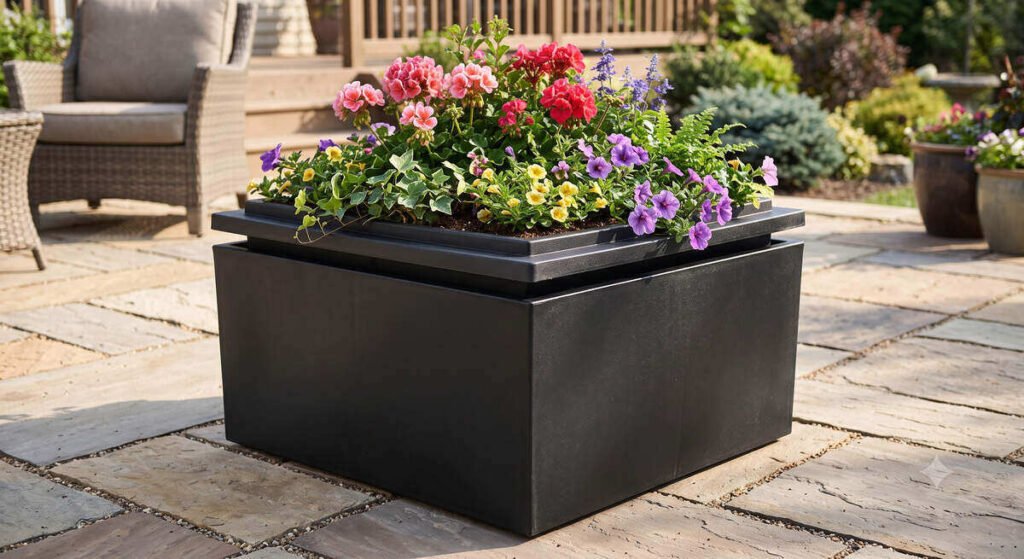
Mayne’s Fairfield line is made in the USA from UV-stable, double-wall polyethylene and backed by a 15-year residential warranty — a genuinely long commitment that signals real confidence in the build. The double-wall design insulates roots from temperature swings better than a single-wall plastic pot, and the built-in reservoir includes overflow drainage, so a heavy rain won’t over-saturate the soil even with the reservoir already full.
| Attribute | Detail |
|---|---|
| Dimensions | 20 in. square |
| Reservoir design | Built-in with overflow drainage |
| Material | Double-wall UV-stable polyethylene |
| Warranty | 15-year residential |
| Approximate capacity | Suited to medium-to-large accent plants or small shrubs |
It’s sold in multiple sizes and colors, so the same trusted line scales from a single entryway accent piece to a larger patio planting.
Good for: general-purpose patio and porch planting where you want a planter that lasts many years without replacement. Skip if: you’re specifically growing vining vegetables that need a trellis, or you need a railing-mount option — this is a floor-standing planter only.
Best for tomatoes and vining plants: Vego Garden Self-Watering Rolling Tomato Planter
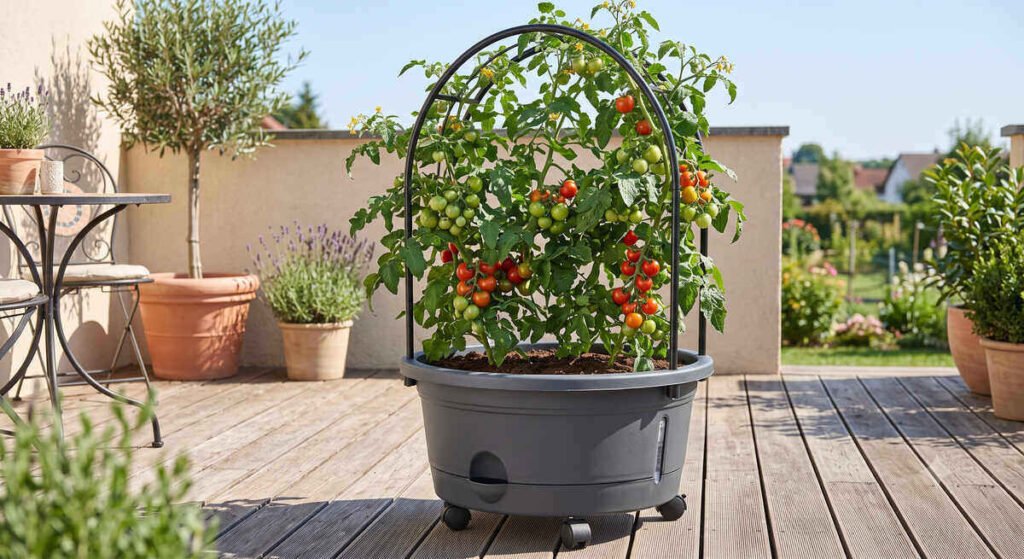
This planter pairs a self-watering reservoir (2.4-gallon capacity) with a built-in curved trellis, purpose-built for tomatoes, peppers, cucumbers, and other plants that need vertical support — solving two problems (watering and staking) with one product instead of buying a planter and a separate cage. Rolling wheels make it easy to chase sun through the season or bring plants closer to shelter before a storm, which matters more for vining vegetables than for smaller ornamental plants given how much a fully grown tomato plant can be affected by wind exposure.
According to Vego Garden, the planter body is made partly from recycled ocean plastic, and the trellis links use a bioplastic derived from recycled agricultural waste — a sustainability angle worth noting, though these are manufacturer-stated claims we haven’t independently verified.
Good for: growing tomatoes, peppers, or cucumbers on a patio or balcony without buying a separate cage or trellis. Skip if: you’re growing non-vining plants like herbs or flowers — the trellis is dead weight you’re paying for and don’t need.
Best budget: Bloem Ariana Self-Watering Planter
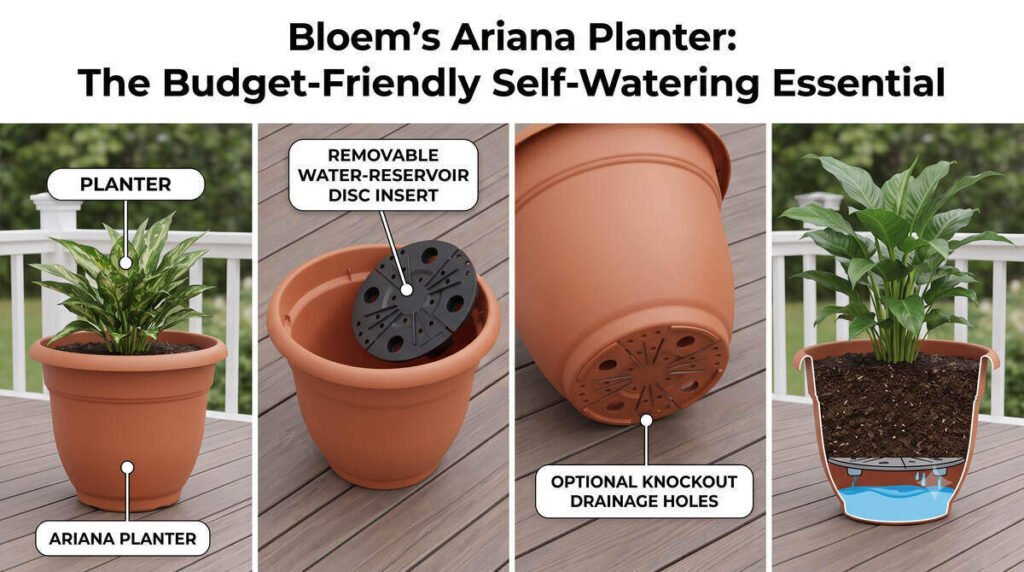
Bloem’s Ariana planter delivers the core self-watering mechanism — a removable water-reservoir disc insert — in a lightweight, UV-stabilized plastic pot at a fraction of the cost of the premium options in this roundup. Optional knockout drainage holes let you configure it for either strict self-watering use or traditional drainage, depending on what you’re growing.
It won’t match the longevity of Mayne’s double-wall build or the specialized function of Vego’s trellis system, but for a first self-watering planter, or for outfitting several smaller plants without a large budget, it covers the core job reliably.
Good for: budget-conscious buyers, first-time self-watering planter users, or anyone equipping multiple smaller plants at once. Skip if: you want the longest possible outdoor lifespan — thinner plastic construction won’t hold up to years of direct sun exposure as well as Mayne’s double-wall design.
Best raised-bed style: Keter Urban Bloomer
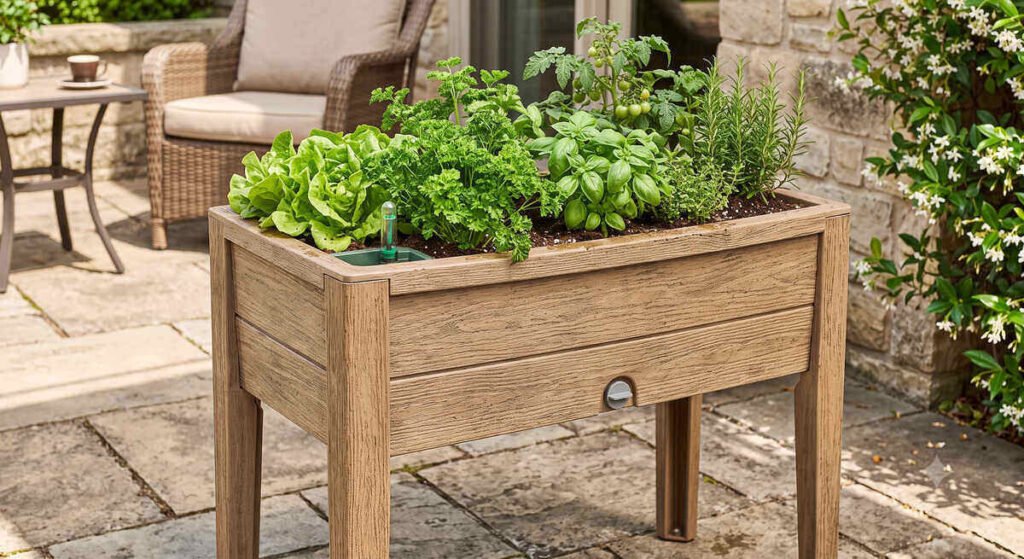
We’re including this alongside conventional self-watering pots because the buying intent overlaps: shoppers comparing self-watering planters for a patio or balcony are often deciding between a standard planter and an elevated, higher-capacity option like this one — not choosing between two entirely separate categories. The Urban Bloomer is a step up in scale from a standard planter — a 12.7-gallon elevated raised bed with a built-in water reservoir, drainage plug, and gauge, sized for real vegetable and herb growing rather than a single ornamental plant. The elevated height means no bending or kneeling, and the heavy-duty resin construction resists the rusting and rotting that affects metal or wood alternatives over time.
Its footprint is compact enough to fit alongside patio furniture without dominating the space, striking a middle ground between a full raised garden bed and a standard planter.
Good for: patio or balcony gardeners who want real vegetable-growing capacity without a full in-ground or floor-level raised bed, or anyone who wants to avoid bending down to tend plants. Skip if: you have a small balcony with limited floor space — its footprint is larger than a standard planter or railing box.
Best for railings: Lechuza Balconera
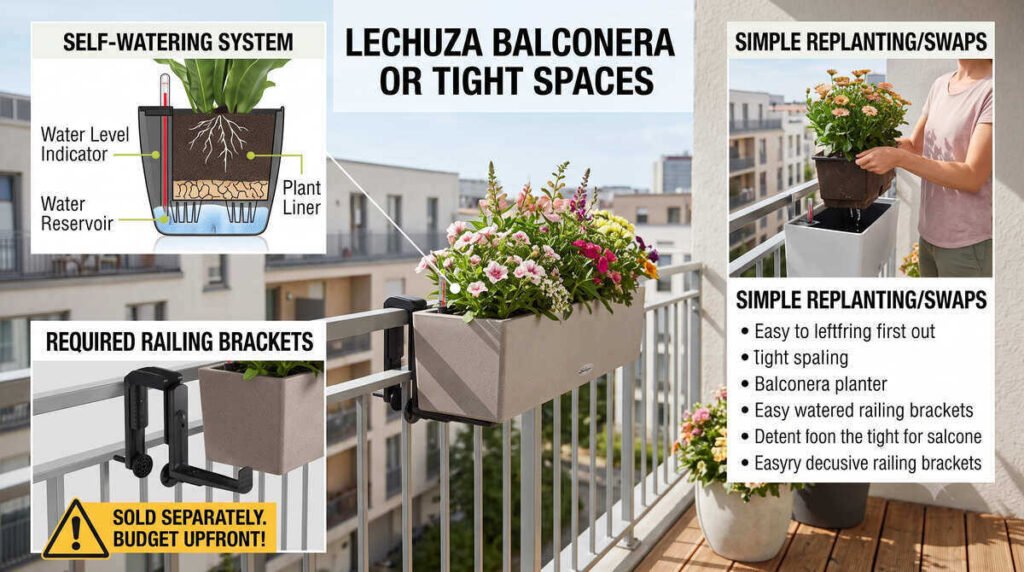
Lechuza’s Balconera line is designed specifically to hang on a balcony or window railing rather than sit on the floor, which makes it the strongest pick for genuinely tight balconies with little or no usable floor space. The planter uses Lechuza’s own water reservoir and level indicator system, made in Germany, with a lift-out planted liner that makes replanting or seasonal swaps simple without disturbing the mounting brackets.
Brackets are sold separately, which is worth budgeting for upfront rather than as an afterthought, since the planter isn’t functional as a railing mount without them.
Good for: balconies and railings with no usable floor space, or anyone who wants planters visible from both inside and outside a window. Skip if: you need a large-capacity planter for vegetables — Balconera’s shallow, narrow profile suits herbs and flowers better than deep-rooted vegetables.
Choosing by space, not just by plant
Floor space available? A standard self-watering planter (Mayne, Bloem) or a raised-bed style (Keter) needs floor or ground space. If you don’t have it, a railing-mounted option like Lechuza is the only realistic category.
What are you growing? Vining vegetables benefit specifically from a planter with integrated trellis support (Vego Garden) rather than a standard pot plus a separate cage. Herbs and flowers do fine in any of the smaller options.
How long do you want it to last? Double-wall, warrantied construction (Mayne) costs more upfront but avoids replacement for many years. Budget plastic (Bloem) is a reasonable choice if you’re not committing to the same spot long-term, or want to test whether self-watering suits your routine before investing more.
How much are you actually growing? A single accent plant needs far less reservoir capacity than a full tomato plant or several herbs in one container — match reservoir size to plant count and mature size, not just to the space available.
Frequently asked questions
How often do I need to refill a self-watering planter’s reservoir? Refill intervals vary widely — from several days to a few weeks — depending on reservoir size, plant maturity, temperature, sunlight, and water demand. Hot U.S. summer conditions can push some containers toward the more frequent end of that range regardless of reservoir size. A visible water-level gauge, where included, removes the guesswork.
Can I use a self-watering planter for vegetables, or is it just for flowers? Both work well, provided the reservoir and soil capacity are appropriately sized. Larger vegetables like tomatoes need more root space and water than a small decorative planter offers — that’s why a dedicated vegetable-focused option like Vego Garden’s trellis planter or Keter’s raised-bed style suits vegetables better than a small ornamental pot.
Do self-watering planters work in full sun, or do they overheat? Most are designed for full outdoor sun exposure, but material matters — UV-stabilized plastic resists the fading and brittleness that non-UV-rated plastic can develop after a season or two in direct sun. Check each product’s specific listing for UV-resistance claims rather than assuming it applies universally across every planter.
What happens if I forget to refill the reservoir? The plant reverts to relying on whatever moisture remains in the soil, similar to a standard pot — it doesn’t fail immediately, but the buffer against a missed watering is gone until the reservoir is refilled. Self-watering planters extend your margin for error; they don’t eliminate the need for water entirely.
Is a self-watering planter better than a regular pot with a saucer? For most patio and balcony use, yes — a saucer collects water at the bottom but doesn’t actively regulate how much the plant draws up, so plants can still sit in too much water or dry out between waterings. A true reservoir system with a wicking mechanism manages that balance more consistently.
How we put this comparison together
This roundup is built from published manufacturer specifications, verified retailer listings, and aggregated third-party test data and owner feedback for each product — not from in-house hands-on testing at this time. Where a claim comes from a manufacturer spec sheet rather than independent verification, we’ve noted it as such. As we complete hands-on testing on individual planters, we’ll update this post and link out to full individual reviews with our own first-hand notes.
Further reading
- University of Maryland Extension: Container Vegetable Gardening — sizing and watering guidance relevant to self-watering containers.
- Our Best Containers for Vegetable Gardening guide, for fabric grow bags and larger container options.
- Our Best Vertical Garden & Trellis Systems comparison, if you need standalone trellis support beyond what a planter includes.
Sources referenced
- https://www.amazon.com/Mayne-Fairfield-5825B-Planter-20-Inch/dp/B002YVQCBO
- https://www.amazon.com/Vego-garden-Self-Watering-Climbing-Vegetables/dp/B0CTQPP56P
- https://www.amazon.com/Bloem-Ariana-Watering-Planter-AP1012/dp/B01KTLUVSU
- https://www.amazon.com/Keter-Bloomer-Plastic-Elevated-Graphite/dp/B079SQRL46
- https://www.amazon.com/Lechuza-Balconera-Cottage-All-One/dp/B003JBTW2O
Note: prices and availability on Amazon fluctuate frequently. We verify links prior to publishing, but please check the current price on the live page.
This completes our Gardening buying guide series. Next: a container gardening watering schedule guide by climate zone.
The GoEfte editorial team researches and compares yard, garden, and water products, drawing on manufacturer specs, horticultural extension guidance, and verified owner reviews to help homeowners choose the right gear for their space and budget.