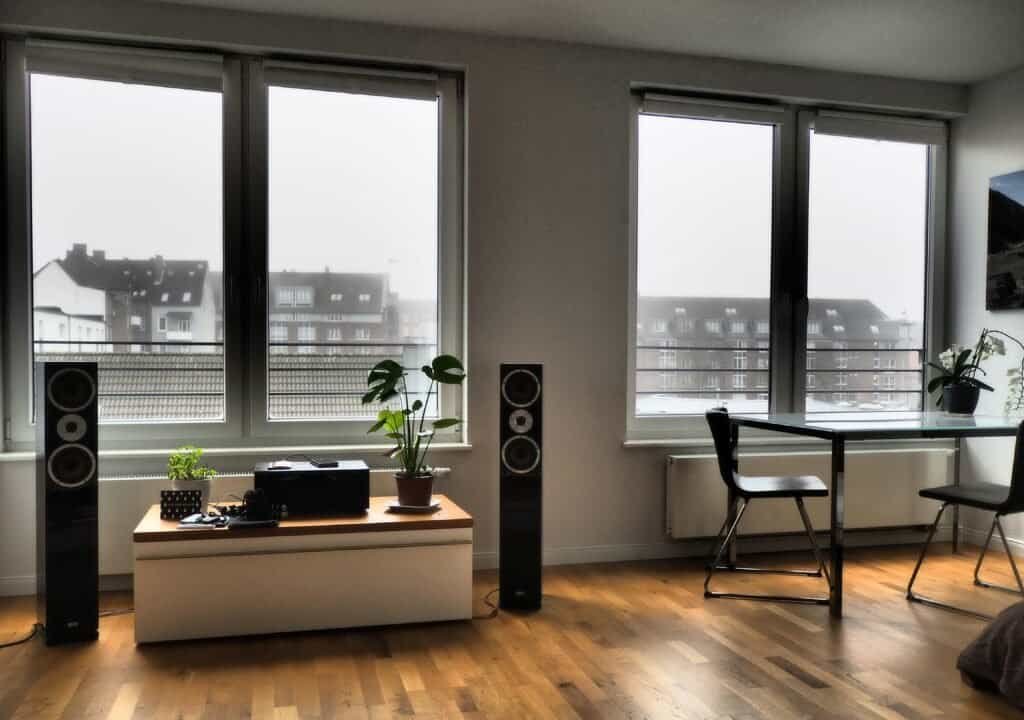
One of the most enjoyable upgrades you can make to a connected home is a multi-room audio system. There is something truly transformative about walking from your living room to the kitchen, or out to the patio, while your favorite playlist follows you seamlessly without missing a beat.
Gone are the days of expensive built-in wired systems that required tearing open walls and hiring specialist contractors. The modern “smart jukebox” is wireless, modular, and controllable entirely from the palm of your hand. In this guide, we explore how to build a high-fidelity audio network that fills your home with sound while remaining visually minimalist.
New to smart homes? Start with our Ultimate Guide for Beginners to understand the basics before building your audio system.
Part 1: The Evolution of Whole-Home Audio
In the past, high-end audio was a static experience. You sat in one room with two large speakers and a bulky amplifier. Today, audio is fluid. A multi-room system consists of several speakers placed throughout the house that connect over your home’s Wi-Fi network. Unlike traditional Bluetooth speakers, these systems allow you to play different songs in different rooms simultaneously or group them all together for a “Party Mode” that keeps the entire house in perfect sync.
Why Wi-Fi Beats Bluetooth
For a high-quality smart home, Wi-Fi-based audio is the standard. Bluetooth is limited by range and often interrupts your music with notification pings or phone calls. Wi-Fi audio, however, streams directly from the cloud to the speaker. This means your phone acts only as a remote, leaving your audio uninterrupted even if you leave the house or take a call.
Part 2: Choosing Your Audio Ecosystem
When building your system, the most important decision is selecting an ecosystem. For a perfectly synchronized experience where every speaker plays in exact time, it is usually best to stick to one brand.
| System Type | Best For | Key Feature |
|---|---|---|
| Audiophile | Music lovers | Room-tuning software for rich, deep sound |
| Assistant-Integrated | Voice control fans | Seamless smart home integration with Alexa/Google |
| Spatial Audio | Immersive experience | Dolby Atmos, 3D soundstage with upward-firing drivers |

The Audiophile’s Choice (High Fidelity)
Some systems are designed specifically for music lovers. They offer proprietary software that “tunes” the speaker to the unique acoustics of your room. These systems are an investment, but they provide a rich, deep sound that rivals traditional wired setups.
The Assistant-Integrated Choice (Maximum Convenience)
If your primary goal is voice control, look toward speakers developed by the major ecosystem providers. These devices prioritize the “Smart” in smart speaker, allowing you to ask for specific genres, weather updates, or control your lights while listening to music. While the sound quality is generally good, the focus here is on seamless integration with the rest of your home’s routines.
The Versatile 3D Audio Choice
Recent advancements have brought “Spatial Audio” and “Dolby Atmos” into the home. Certain high-end smart speakers use upward-firing drivers to bounce sound off your ceiling, creating a 3D soundstage that makes it feel like the band is playing right in the middle of your room.
Part 3: Strategic Planning for Every Room
You don’t need to outfit every room at once. The best approach is to start with your “Gathering Spaces” and expand as your needs grow.
The Living Room: The Double-Duty Hub
In the living room, your audio system should serve two purposes: high-fidelity music and home theater sound. By choosing a smart soundbar for your television, you create a hub that can anchor your entire home audio network. When the TV is off, the soundbar acts as a powerful music speaker.
Explore our Buying Guides for soundbar and speaker recommendations.
The Kitchen: The Heart of the Home
The kitchen is often the busiest room in the house. A mid-sized, humidity-resistant speaker is ideal here. Because kitchen surfaces are often hard (marble, tile), choose a speaker with good mid-range clarity so you can hear podcasts or news clearly over the sound of cooking.
The Bedroom and Bathroom: Private Sanctuaries
For the bedroom, aesthetics are key. Look for speakers with fabric finishes that match your bedding or furniture. In the bathroom, ensure your hardware is rated for high humidity. Many modern smart speakers are designed specifically to handle the moisture of a shower environment without degrading the internal components.
Part 4: The “Invisible” Luxury Look
For the true minimalist, even the most beautiful speaker is still an object on a shelf. To achieve a “Zero-Clutter” look, you can move the technology into the architecture of the home.

In-Ceiling and In-Wall Integration
If you are renovating, consider architectural speakers. These are installed flush with the drywall or ceiling. When the grilles are painted to match your paint color, the technology completely disappears. You power these through a hidden “Smart Amp” tucked away in a closet. The result is a home where music seems to come from the very air around you.
Part 5: Connectivity Standards (AirPlay 2 and Cast)
Beyond the brand of the speaker, you should look for universal connectivity standards.
- Apple AirPlay 2: Essential for iPhone users. It allows you to stream audio from any app (YouTube, TikTok, Netflix) directly to your speakers.
- Google Cast: Similar to AirPlay, this is the standard for Android users, allowing high-resolution streaming from hundreds of apps.
- Spotify Connect: This allows the Spotify app to hand off the stream directly to the speaker, saving your phone’s battery life.
Part 6: Creating Audio “Scenes”
A smart jukebox is about more than just playing music; it’s about setting a mood. By using your home’s automation features, you can create “Audio Scenes”:

The Morning Routine
At 7:00 AM, the bathroom and kitchen speakers softly play the morning news or a “Coffee House” playlist at 20% volume.
The Welcome Home
When your smart lock detects you’ve arrived, your favorite “Chill” playlist starts playing in the hallway and living room.
The Party Mode
With
one command, every speaker in the house syncs to 50% volume, ensuring
guests hear the same music whether they are in the kitchen or the
backyard.
Your Multi-Room Audio Starter Checklist
Copy this list and check off as you build:
☐ Choose your ecosystem (Audiophile, Assistant, or Spatial)
☐ Start with 1 speaker in main living area
☐ Add a second speaker in kitchen/bedroom
☐ Set up your first audio scene (Morning, Welcome Home)
☐ Expand to outdoor/patio speakers
☐ Consider architectural speakers for renovation projects
Key Takeaways
Wi-Fi-based audio is superior to Bluetooth for whole-home systemsChoose one ecosystem for perfect synchronizationStart with gathering spaces, expand graduallyArchitectural speakers offer invisible luxuryAudio scenes transform daily routines
Explore our Buying Guides for speaker recommendationsRead our Ultimate Smart Home Guide for a complete overviewCheck out more Entertainment ideas for your smart home